Technical comparison
SkyTechSport vs MaxxTracks
A revolving indoor ski slope and an actively-driven simulator both let you ski without snow — but they suit different goals. A factual, sourced comparison.
By the SkyTechSport team · Last updated June 2026
Methodology
Based on each manufacturer's publicly available information as of June 2026 and the documented behaviour of revolving-deck and actively-driven-platform technology. Where MaxxTracks does not publish a figure, we mark it "Not publicly disclosed" rather than estimate. SkyTechSport figures are our own published specifications.
Side by side.
| MaxxTracks | SkyTechSport | |
|---|---|---|
| Core technology | Revolving-carpet indoor ski slope (ski deck); the belt moves under the skier. | An actively-driven platform that recreates the forces and movements of a real turn — sensors and motors, not a moving surface. |
| Carving fidelity | Fall-line belt; favors low-edge-angle, skid-assisted turns. | Reproduces progressive edge loading; technique transfers to snow. |
| Lateral G-force | Minimal — skier not accelerated sideways. | Up to 2.5 G of lateral load. |
| Footprint | Up to ~7 × 11 m (23 × 36 ft) for large models; custom-sized to the venue. | 3 × 3 m (10 × 10 ft, Racer) to 7.5 × 4.5 m (25 × 15 ft, Olymp). |
| Installation | A large, heavy machine — tall ceilings plus forklifts or lifting equipment are commonly required, with a technician crew assembling the track on site over a more involved install. | Delivered and installed; far smaller weight, space and civil requirement. |
| Digital experience | Not publicly disclosed (not a core feature of the deck). | Virtual resorts, racing, gamified sessions, updated content. |
| Performance analytics | Not publicly disclosed | Per-run metrics via the SkyTechSport app. |
| Published pricing | Not publicly disclosed | From $41,030 (Racer) · $88,220 (President) · $120,890 (Olymp). |
Core technology
MaxxTracks
Revolving-carpet indoor ski slope (ski deck); the belt moves under the skier.
SkyTechSport
An actively-driven platform that recreates the forces and movements of a real turn — sensors and motors, not a moving surface.
Carving fidelity
MaxxTracks
Fall-line belt; favors low-edge-angle, skid-assisted turns.
SkyTechSport
Reproduces progressive edge loading; technique transfers to snow.
Lateral G-force
MaxxTracks
Minimal — skier not accelerated sideways.
SkyTechSport
Up to 2.5 G of lateral load.
Footprint
MaxxTracks
Up to ~7 × 11 m (23 × 36 ft) for large models; custom-sized to the venue.
SkyTechSport
3 × 3 m (10 × 10 ft, Racer) to 7.5 × 4.5 m (25 × 15 ft, Olymp).
Installation
MaxxTracks
A large, heavy machine — tall ceilings plus forklifts or lifting equipment are commonly required, with a technician crew assembling the track on site over a more involved install.
SkyTechSport
Delivered and installed; far smaller weight, space and civil requirement.
Digital experience
MaxxTracks
Not publicly disclosed (not a core feature of the deck).
SkyTechSport
Virtual resorts, racing, gamified sessions, updated content.
Performance analytics
MaxxTracks
Not publicly disclosed
SkyTechSport
Per-run metrics via the SkyTechSport app.
Published pricing
MaxxTracks
Not publicly disclosed
SkyTechSport
From $41,030 (Racer) · $88,220 (President) · $120,890 (Olymp).
The difference in one line
A smaller footprint, a deeper turn.
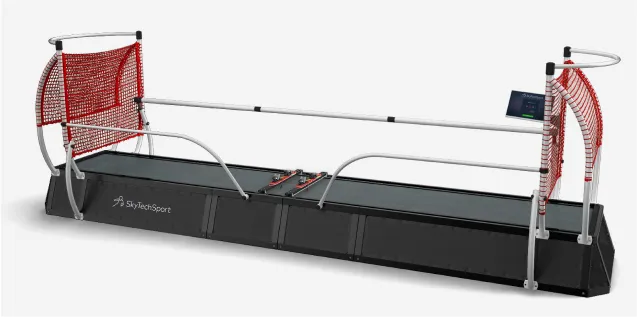
A large revolving slope can require up to ~7 × 11 m (23 × 36 ft) and moves a belt under the skier. A SkyTechSport platform recreates the forces of the carved turn — up to 2.5 G of lateral load — in a 3 × 3 m (10 × 10 ft) to 7.5 × 4.5 m (25 × 15 ft) footprint, with virtual resorts and analytics.
A fair word
Where MaxxTracks may suit you.
If you want a large, custom-built revolving slope as a high-throughput teaching surface or a venue attraction — and you have the space and budget for a turn-key install — MaxxTracks is a long-established maker of indoor ski slopes and may fit that brief.
If you want carving fidelity, lateral G-force, a compact footprint, virtual content and analytics, and transparent published pricing, an actively-driven SkyTechSport simulator is the stronger fit.
Compare for yourself.
Book a demo to feel the platform, or build and price a simulator for your venue or home.
SkyTechSport vs MaxxTracks — FAQ
What is the difference between SkyTechSport and MaxxTracks?
Is MaxxTracks the same as Maxtrax?
How much space does each need?
Which is better for a resort or attraction?
Sources & notes
- MaxxTracks dimensions ("up to 7 × 11 m / 23 × 36 ft") and installation — maxxtracks.com published materials, June 2026; pricing and digital features not publicly disclosed at that date.
- SkyTechSport specifications and pricing — skytechsport.com / config.skytechsport.com, June 2026.
- Revolving-deck vs actively-driven-platform behaviour — see the carving physics explainer.
MaxxTracks is a trademark of its respective owner (and is unrelated to "Maxtrax" recovery boards). This independent comparison is based on publicly available information and is not affiliated with, sponsored by, or endorsed by that company.