Technical explainer
Why revolving carpets can't reproduce true carving
A fair, physics-first look at carving on a ski deck — what's genuinely possible, what isn't, and why an actively-driven platform behaves differently.
By the SkyTechSport team · Last updated June 2026
The short answer
Ski decks favor low-edge-angle, skid-assisted turns and cannot reproduce the progressive lateral loading of snow or of an actively-driven platform. You can carve somewhat on a modern deck — but the force, timing and edge commitment of a true carved turn are hard to rehearse on a belt that only moves in the fall-line.
What a carved turn actually is
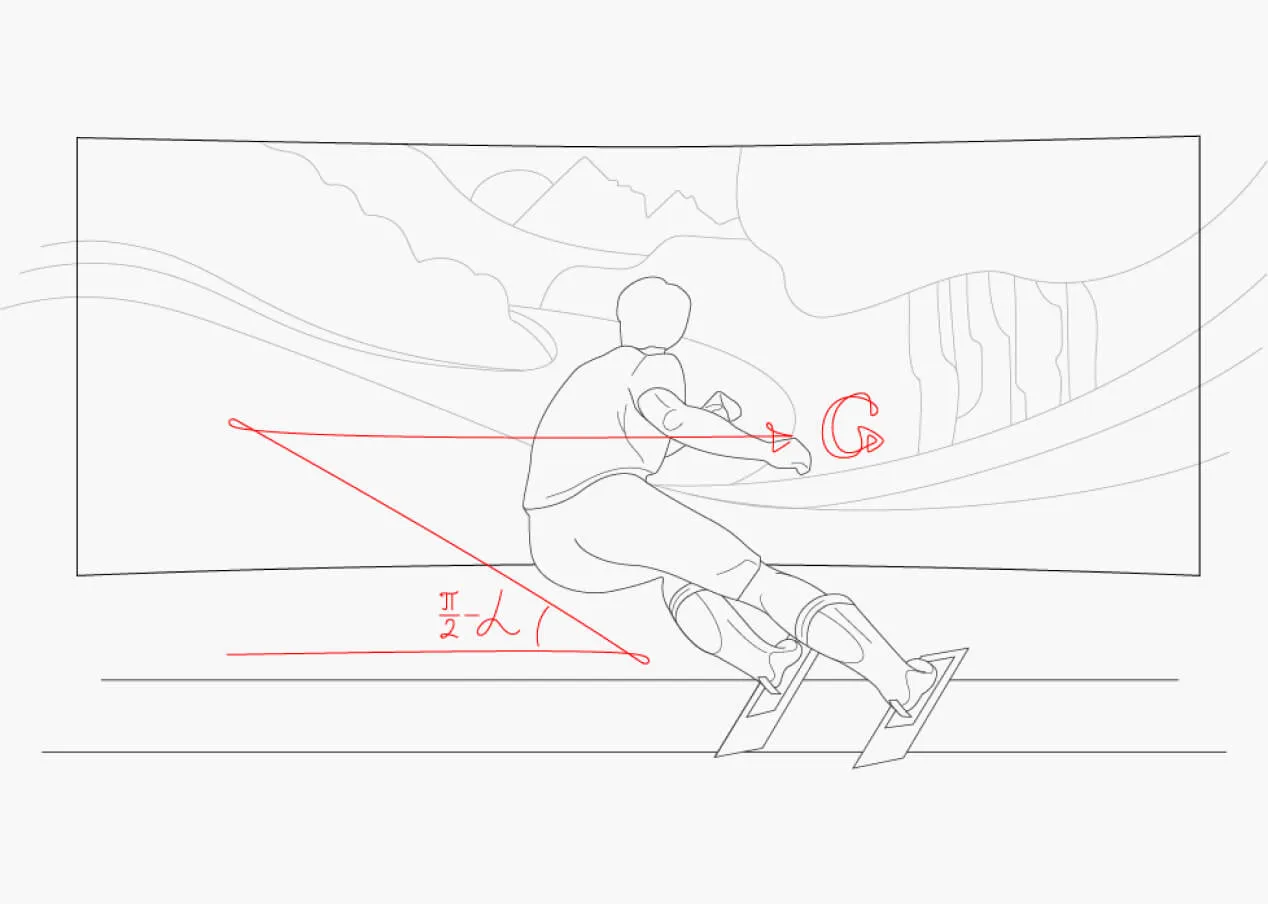
On snow, you carve by tipping the ski onto a high edge angle so its sidecut bends into an arc, then loading it progressively. That load accelerates you sideways — the lateral G-force every skier feels at the belly of a good turn. Carving is, fundamentally, a sideways-loading event.
What a revolving deck does
A deck's belt travels in one direction — the fall-line — and the skier stays roughly in place. There's no mechanism to throw the skier sideways, so the natural technique is a smaller, lower-edge-angle, skid-assisted turn. Variable-height bristles let you carve to a degree, but the deep, progressively-loaded carve of snow has nowhere to express itself.
What an actively-driven platform adds
Instead of moving a surface under a static skier, a SkyTechSport simulator moves the skier through the turn and generates up to 2.5 G of lateral load — restoring the strength, timing and edge commitment of a real carve, which is why the technique transfers to the hill.
In fairness: none of this makes a deck useless. For beginners, a deck is a fine way to feel sliding and learn the snowplow and first edges. The carving gap matters most once a skier is developing intermediate-and-up technique, or training for performance.
Feel the difference.
Lateral loading is something you have to feel. Book a demo, or read the full simulator-vs-deck buyer's guide.
Carving & G-force — FAQ
Can you carve on a ski deck?
Why is carving different on a revolving deck?
Does a ski simulator reproduce G-force?
Is a ski deck still useful for learning?
Sources
- Dry-slope / revolving-surface carving behaviour — edge engagement is quicker and less damped than snow; variable-height bristle surfaces; speed control relies on turn shape and skidding (dry-slope technique references), June 2026.
- SkyTechSport platform lateral load up to 2.5 G — manufacturer specification, June 2026.