Buyer's Guide
Ski simulator vs ski deck
Two ways to ski without snow — but they train very different skills. A clear comparison of revolving ski decks and actively-driven simulators, to help a school, resort, gym or home choose.
By the SkyTechSport team · Last updated June 2026
The short answer
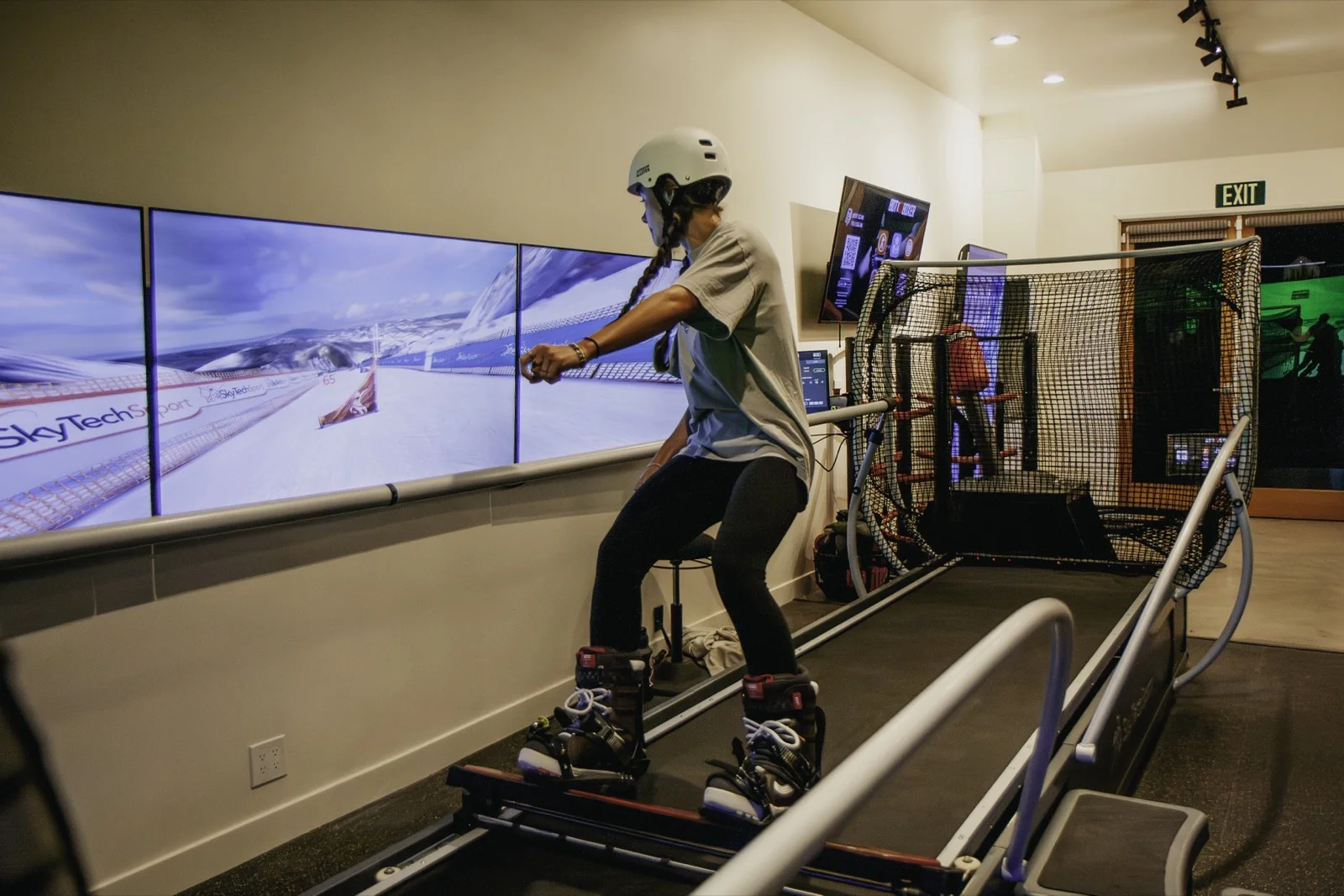
A ski deck is a revolving carpet that moves under a skier who stays in place — great for learning to slide. A ski simulator recreates the physics of a real turn: as you tip the skis and apply pressure, sensors and powerful motors reproduce the gravity and centrifugal loading you'd feel on snow — the same timing, loading and movement patterns. For first-time sliding and throughput a deck can work; for real technique and year-round practice across every level, a simulator is the more capable tool.
The two machines
One moves the surface. One moves the skier.
Revolving ski deck
An inclined loop of carpet or brush that travels continuously. You ski "down" it while staying roughly in place — intuitive for snowplow and first edges. What is a ski deck →
Ski simulator
An actively-driven platform carries the skier through the edging, weight transfer and lateral loading of a real turn — up to 2.5 G — against a fixed surface and a wraparound screen showing a resort run. Explore the simulator →
Side by side
The full comparison.
Based on each category's published specifications and documented behaviour as of June 2026. Where a vendor does not publish a figure, we say so rather than estimate.
| Revolving ski deck | SkyTechSport simulator | |
|---|---|---|
| How it moves | A carpet or brush belt travels under a skier who stays roughly in place (fall-line motion only). | An actively-driven platform recreates the forces and movements of a real turn — sensors and motors load the skier exactly as gravity and centrifugal force do on snow, against a fixed surface and a wraparound screen. |
| What it trains best | Beginner basics: snowplow, first edges, balance, immediate visual feel. | Full progression: carved & parallel turns, fore/aft balance, inside/outside ski weighting, lead change, race lines. |
| Carving fidelity | Favors low-edge-angle, skid-assisted turns; modern surfaces allow some carving but edge feedback is sharper and less damped than snow. | Reproduces progressive edge loading and edge-to-edge transition close to snow; technique transfers to the hill. |
| Lateral G-force | Minimal — the skier is not accelerated sideways. | Up to 2.5 G of lateral load, the force that builds real carving strength and timing. |
| Footprint | Large for training models — up to ~7 × 11 m (23 × 36 ft) for the biggest commercial decks. | From 3 × 3 m (10 × 10 ft, Racer) to 7.5 × 4.5 m (25 × 15 ft, flagship Olymp) — fits homes, studios and lobbies. |
| Installation | A large, heavy machine — tall ceilings plus forklifts or lifting equipment are commonly required, and a technician crew assembles the track on site over a more involved install. | Delivered and installed by SkyTechSport; far smaller weight, space and civil requirement. |
| Maintenance | Belt/surface wear over time; depends on surface type (some need lubrication, some none). | Engineered drive system with manufacturer support and warranty. |
| Digital & virtual | Limited; varies by vendor, often none. | Virtual resorts, racing, games and training content, plus a mobile app — regularly updated. |
| Performance analytics | Generally none. | Mobile app with statistics, performance history and global leaderboards. |
| Throughput | Some decks can accommodate multiple users, but all share one moving surface and speed, so it takes careful coordination — in practice many operators run one skier or a very small group, depending on the lesson format. | One focused skier per unit; sessions rotate quickly with instant resets and metrics. |
| Indicative price | Not publicly disclosed by most vendors; commercial decks are a major capital install. | Published: from $41,030 (Racer) · $88,220 (President) · $120,890 (Olymp). |
| Best suited to | Entry-level sliding, fun attractions, first-timer throughput. | Everyone — beginners, recreational skiers and families; instructors, ski schools and athletes; year-round training and premium entertainment. |
How it moves
Revolving ski deck
A carpet or brush belt travels under a skier who stays roughly in place (fall-line motion only).
SkyTechSport
An actively-driven platform recreates the forces and movements of a real turn — sensors and motors load the skier exactly as gravity and centrifugal force do on snow, against a fixed surface and a wraparound screen.
What it trains best
Revolving ski deck
Beginner basics: snowplow, first edges, balance, immediate visual feel.
SkyTechSport
Full progression: carved & parallel turns, fore/aft balance, inside/outside ski weighting, lead change, race lines.
Carving fidelity
Revolving ski deck
Favors low-edge-angle, skid-assisted turns; modern surfaces allow some carving but edge feedback is sharper and less damped than snow.
SkyTechSport
Reproduces progressive edge loading and edge-to-edge transition close to snow; technique transfers to the hill.
Lateral G-force
Revolving ski deck
Minimal — the skier is not accelerated sideways.
SkyTechSport
Up to 2.5 G of lateral load, the force that builds real carving strength and timing.
Footprint
Revolving ski deck
Large for training models — up to ~7 × 11 m (23 × 36 ft) for the biggest commercial decks.
SkyTechSport
From 3 × 3 m (10 × 10 ft, Racer) to 7.5 × 4.5 m (25 × 15 ft, flagship Olymp) — fits homes, studios and lobbies.
Installation
Revolving ski deck
A large, heavy machine — tall ceilings plus forklifts or lifting equipment are commonly required, and a technician crew assembles the track on site over a more involved install.
SkyTechSport
Delivered and installed by SkyTechSport; far smaller weight, space and civil requirement.
Maintenance
Revolving ski deck
Belt/surface wear over time; depends on surface type (some need lubrication, some none).
SkyTechSport
Engineered drive system with manufacturer support and warranty.
Digital & virtual
Revolving ski deck
Limited; varies by vendor, often none.
SkyTechSport
Virtual resorts, racing, games and training content, plus a mobile app — regularly updated.
Performance analytics
Revolving ski deck
Generally none.
SkyTechSport
Mobile app with statistics, performance history and global leaderboards.
Throughput
Revolving ski deck
Some decks can accommodate multiple users, but all share one moving surface and speed, so it takes careful coordination — in practice many operators run one skier or a very small group, depending on the lesson format.
SkyTechSport
One focused skier per unit; sessions rotate quickly with instant resets and metrics.
Indicative price
Revolving ski deck
Not publicly disclosed by most vendors; commercial decks are a major capital install.
SkyTechSport
Published: from $41,030 (Racer) · $88,220 (President) · $120,890 (Olymp).
Best suited to
Revolving ski deck
Entry-level sliding, fun attractions, first-timer throughput.
SkyTechSport
Everyone — beginners, recreational skiers and families; instructors, ski schools and athletes; year-round training and premium entertainment.
Sources listed at the foot of this page.
The core difference
Carving is a sideways force.
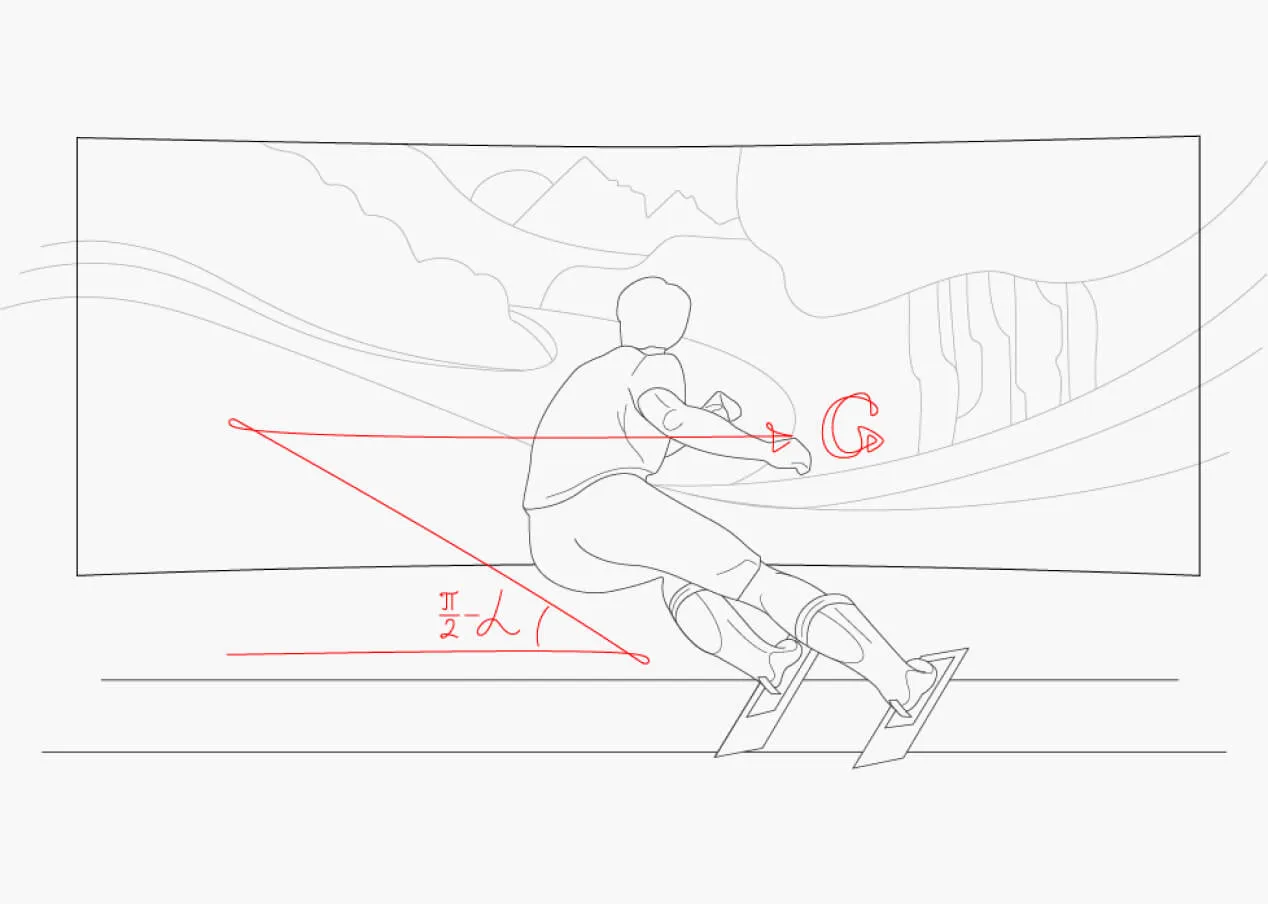
On snow, a carved turn comes from tipping the ski to a high edge angle and loading it progressively — which throws you sideways. A revolving deck only moves in the fall-line, so the skier makes smaller, lower-edge-angle, skid-assisted adjustments and feels little lateral force.
A SkyTechSport platform restores that loading — up to 2.5 G — so the body learns the real timing and strength of a carved turn, and the technique transfers to the hill.
The physics, explainedSpace & operating reality
It has to fit, and keep running.
Space
The largest commercial training decks can require up to roughly 7 × 11 m (23 × 36 ft). SkyTechSport simulators run from 3 × 3 m (10 × 10 ft) (Racer) to 7.5 × 4.5 m (25 × 15 ft) (Olymp) — even the flagship is smaller than the biggest decks.
Installation
Large decks are heavy and tall — they commonly need high ceilings and forklifts or other lifting equipment, with a technician crew assembling the track on site over a more involved install. A simulator is delivered and installed with a far smaller space, weight and civil requirement.
Maintenance
Belt and surface wear vary by deck design — some surfaces need lubrication, some are marketed as needing none. A simulator's drive system is supported by the manufacturer under warranty.
Beyond the hardware
A platform, not just a surface.
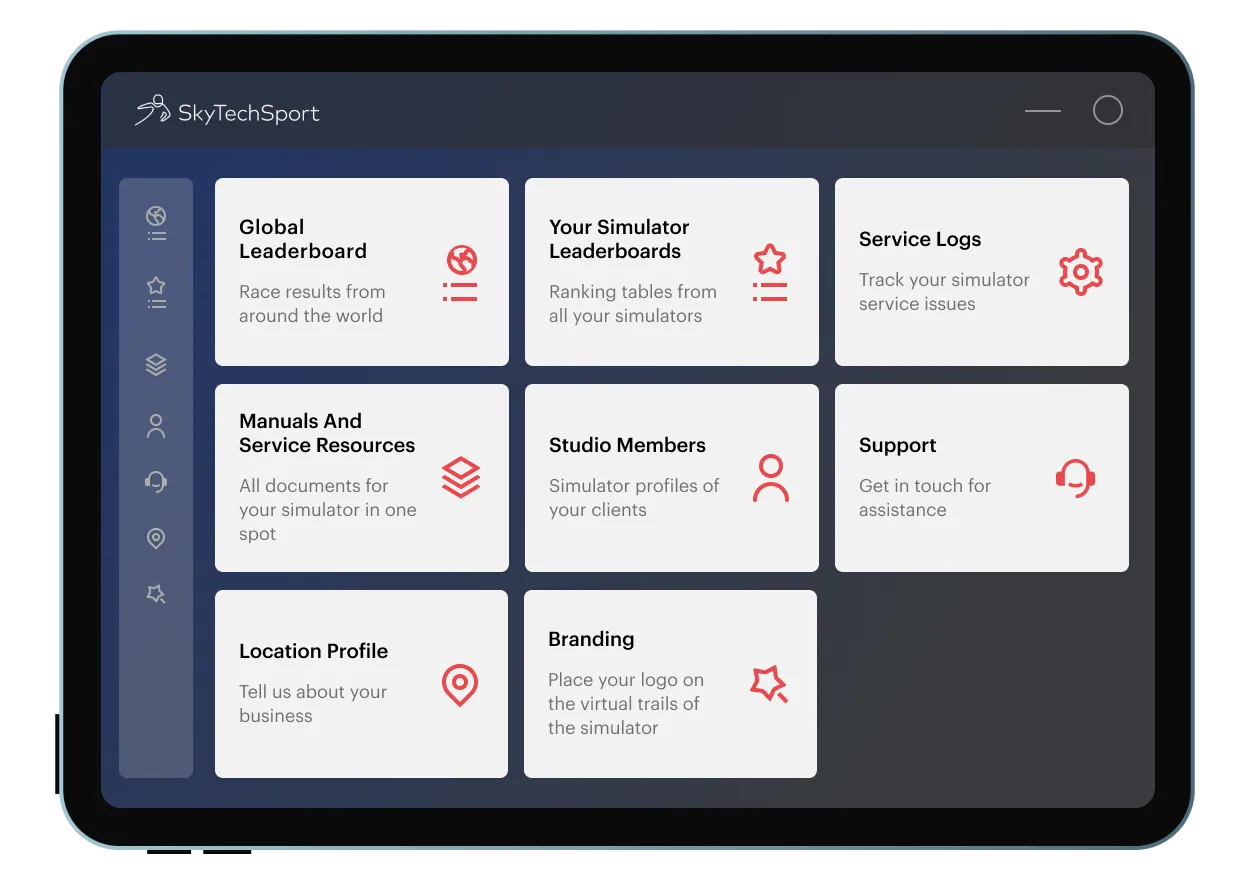
A revolving deck is, fundamentally, a moving surface. A SkyTechSport simulator is a connected platform — for many buyers, the deciding difference.
- Mobile app for skiers & coaches
- Statistics & performance history
- Global leaderboards
- Virtual resorts to ski
- Games & gamified sessions
- Training content, regularly updated
In fairness
Where a ski deck is the better choice.
A ski deck's strongest use case is the very beginning: absolute beginners, a first exposure to sliding, the first few lessons, and introductory balance work. In that window it does its job well.
The limitation is that many skiers progress beyond what a deck can teach fairly quickly — once they're ready to carve, build edge angle and feel real loading, the deck has little more to give. A simulator covers that first window and everything after it.
Which is right for you?
Match it to your goal.
- Ski & snowboard schools
- Simulator
- Students build correct stance, edging and carving from lesson one with instant feedback — and keep teaching year-round, regardless of snow.
- Resorts & attractions
- Either — by goal
- A deck can be a high-throughput novelty; a simulator is a premium, repeatable experience guests return for and that doubles as a training asset.
- Coaches & athletes
- Simulator
- Carved-turn mechanics, lateral G-loading and per-run analytics make off-season technique work transfer to the hill.
- Home buyers
- Simulator
- A 3 × 3 m (10 × 10 ft) footprint, real carving practice and a content library make it a year-round trainer that fits a room, not a warehouse.
Take the comparison with you.
Download the one-page Ski Simulator vs Ski Deck Buyer's Checklist — every question to ask before you invest, in a printable format. Or see a simulator in person.
Ski simulator vs ski deck — FAQ
What is the difference between a ski simulator and a ski deck?
How is a ski deck different than skiing?
Can you carve on a ski deck?
Are ski simulators worth the money?
Do pro skiers use simulators?
How much space does each one need?
How much does a ski simulator cost?
Which is better for a ski school?
Sources
- SkyTechSport simulator specifications and pricing (footprints, up to 2.5 G), skytechsport.com and config.skytechsport.com, June 2026.
- Commercial ski-deck dimensions "up to 7 × 11 m" and turn-key installation, manufacturer published materials (MaxxTracks), June 2026.
- Dry-slope and revolving-surface carving behaviour (edge engagement, low edge angle, skid-assisted speed control), dry-slope technique references.