Why Reaction Times Matter for Skiers & Snowboarders
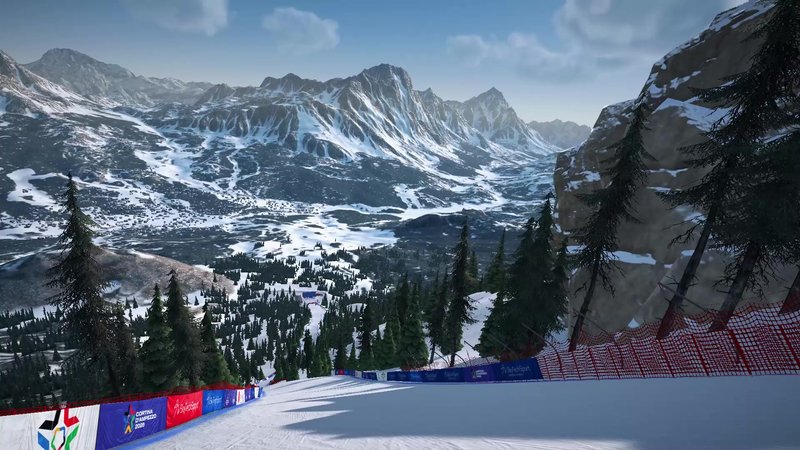
Picture this: you're carving down a blue run when a beginner cuts across your line without warning. In that split second, every millisecond counts. The difference between a smooth correction and a collision often comes down to one underrated athletic quality — reaction time. For skiers and snowboarders of every level, the ability to read, decide, and move fast is just as important as fitness, technique, or equipment. The good news is that reaction time is a trainable skill, and you do not have to be on the mountain to sharpen it.
Why Reaction Time Is Critical on Snow
Skiing and snowboarding are dynamic, unpredictable sports. Terrain changes in an instant — an unexpected mogul, a patch of ice hidden under fresh snow, a slower rider appearing from a blind ridge. Your nervous system has to process that visual or tactile signal, send a motor command, and trigger the right muscle groups before the situation becomes dangerous. This chain of events, from stimulus to movement, is your reaction time.
Beyond safety, faster reactions directly improve your performance. Racers who anticipate gate changes earlier carry more speed through a course. Freestyle riders who respond quickly to lip variations land more consistently. Even recreational skiers feel the benefit: smoother turn initiation, better edge control, and far less of that tense, overcorrecting style that exhausts you by lunchtime. Strong reaction time also reduces cognitive load — when your body responds automatically, your brain stays calm and strategic rather than firefighting.
Simple Reaction-Time Drills You Can Do at Home
You do not need a gym membership or specialist kit to start building faster reactions. The following drills use items most people already have at home and can be done in a living room, hallway, or garden in fifteen to twenty minutes.
Ruler drop test: Hold a standard 30 cm ruler vertically while a training partner grips the bottom without touching it. Drop it without warning. Your partner catches it as fast as possible. The distance it falls before they catch it is a direct measure of reaction time — and a motivating benchmark to beat each session. Tennis ball wall rally: Stand roughly a metre from a solid wall and throw a tennis ball at it with enough pace that it bounces back quickly. Try to catch it with your non-dominant hand, then alternate. Vary the angle and the force to make each return unpredictable. Balance board colour calls: Stand on any balance board or folded yoga mat to add instability, then have a partner call out left, right, or forward. Shift your weight in the called direction as fast as possible. This layer of instability mimics the proprioceptive demands of skiing and forces your stabilising muscles to respond at the same time as your conscious brain. Clap reaction: Lie flat on your back with your arms at your sides. On an audio cue — a clap, a word, or a sound from your phone — jump to your feet as quickly as you can. Simple, brutal, effective.
Why Home Drills Alone Have Their Limits
General reaction drills build the neurological foundation, but they lack the sport-specific context that truly transfers to the mountain. Catching a ruler trains hand speed. What you actually need on snow is the ability to react while managing edge angle, body position, speed, and balance simultaneously — all in a ski boot, on a moving surface. That is a very different cognitive and physical challenge, and replicating it at home without specialist equipment is genuinely difficult.
This is where indoor ski simulation becomes a powerful training tool. Rather than replacing your home drills, it builds on them by placing your reaction training inside a movement pattern that is almost identical to real skiing or snowboarding.
Training Reaction Time on the SkyTechSport Ski Simulator
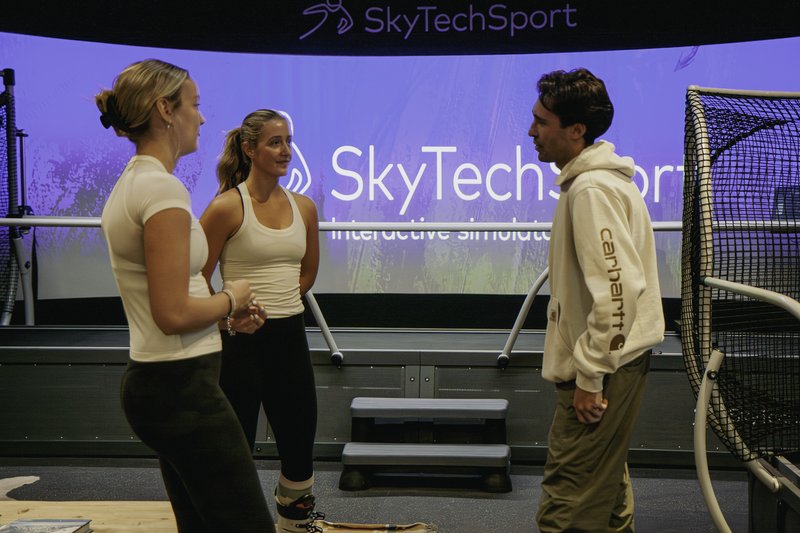
The SkyTechSport ski and snowboard simulator is designed precisely for this kind of integrated training. The platform replicates the lateral weighting, edge pressure, and dynamic balance demands of skiing on a real slope, while the interactive software layer introduces the unpredictability that forces genuine reaction training.
Because the simulator captures your movement data in real time, instructors can set the system to introduce sudden terrain changes, speed variations, or visual cues that require you to adjust your weight and edge in fractions of a second. Unlike a static balance board drill, the consequences of a slow response are immediately felt through the platform — just as they would be on snow. Sessions can be structured progressively: start with predictable cues to build the motor pattern, then layer in random stimuli as your response speed improves. This mirrors the same approach elite alpine coaches use, but in a controlled, year-round indoor environment.
The simulator is also a valuable tool for injury rehabilitation. Skiers returning from knee or ankle injuries often find that their reaction time has deteriorated — partly through deconditioning, partly through protective hesitation. Working on the simulator lets them rebuild both the physical response speed and the mental confidence to react without fear, before they commit to the slopes again.
Building a Reaction-Time Training Routine
The most effective approach combines both methods. Use your home drills three or four times a week as short, sharp sessions — ten to twenty minutes is enough if the intensity is high. Think of them as nervous system warm-ups. Complement these with regular time on the SkyTechSport ski simulator, where the sport-specific environment ensures every neurological gain you make actually translates to better skiing and snowboarding. Even one or two simulator sessions per month throughout the off-season can make a measurable difference to how quickly and confidently you move when the snow arrives.
Track your progress. Use the ruler drop test as a simple benchmark at the start of each training block. The SkyTechSport simulator software also captures response data you can review with your instructor or coach. Seeing objective improvement is one of the most motivating parts of this kind of training — and it makes it very hard to stop.
Start Reacting Faster Before the Season Begins
Reaction time is one of those qualities that skiers and snowboarders rarely train deliberately, yet it underpins almost everything that happens on the mountain — from staying safe in crowded runs to threading a perfect race line. The combination of targeted home drills and time on a SkyTechSport ski simulator gives you a practical, accessible path to genuine improvement. Build the habit now, and by the time the lifts open, your body will be ready to respond before your conscious mind even knows it needs to.
Ready to Train Smarter This Season?
Get in touch to find out how the SkyTechSport ski simulator can fit into your training programme.
Reflex Training Game →